G is for Grapes: A Fun Alphabet Adventure for Preschoolers (Free Printable Worksheet Included!)

Quick answer: This free printable letter G worksheet set gives preschool and kindergarten children (ages 3–6) three practice pages — uppercase G tracing, lowercase g tracing, and a G is for Grapes coloring page. It focuses on the hard /g/ sound in goat and grapes, the sound preschoolers learn first. Download the PDF instantly — no email sign-up required.
What Is Included in This Letter G Worksheet?
This letter G worksheet set includes three ready-to-print pages designed for preschool and kindergarten practice:
- Uppercase G Tracing Page — dotted-line rows for repeated capital G practice
- Lowercase g Tracing Page — dotted-line rows for lowercase g practice
- G is for Grapes Coloring Page — line art grapes picture paired with the word GRAPES
Every page is black-and-white, sized for US Letter or A4 paper, and ready to print with no extra prep.
Skills Your Child Builds with This Letter G Worksheet
About the Letter G — Facts for Parents and Teachers
G is the seventh letter of the English alphabet, sitting between F and H. It's a consonant with two distinct sounds: a hard /ɡ/, as in goat and gate, and a soft /dʒ/, as in gem and giant.
For preschoolers, the hard /g/ sound — as in grapes and goat — is usually taught first, since it appears in more of the everyday words young children already use.
Common G words young children encounter first:
- Goat
- Grapes
- Gate
- Gum
- Girl
- Game
- Garden
- Gift
- Goose
- Guitar
One fact worth knowing: the letter G is one of the youngest letters in the Latin alphabet. The ancient Romans created it by adding a small bar to the curve of the letter C, giving Latin a dedicated symbol for the /ɡ/ sound — which is part of why G and C still share the same rounded base shape today.
Hard G vs. Soft G — The Rule Your Child Will Need Again and Again
G is what phonics teachers call a "soft letter" — one of only two consonants in English, alongside C, that changes sound depending on which letter comes next.
Most of the time, G makes its hard /ɡ/ sound, as in goat, gate, and grapes — the sound used on this worksheet. But when G is followed by E, I, or Y, it usually softens to /dʒ/, the sound heard in gem, giant, and gym.
There's also a quieter G rule worth knowing: in gn combinations like gnat and gnaw, the G is silent, and only the /n/ sound is heard.
How to Write Uppercase Letter G — Stroke-by-Stroke Guide
- Start at about the 1 o'clock position and curve counter-clockwise almost all the way around, like drawing a capital C, stopping around the 4 o'clock position.
- From that stopping point, draw a short horizontal line inward toward the center of the letter.
- Add a short vertical line down from the end of that horizontal line — this small hook is what turns a C into a G.

Uppercase G practice rows help preschoolers master the curve-plus-hook stroke before moving to freehand writing.
How to Write Lowercase Letter g — Stroke-by-Stroke Guide
- Draw a small circle, like a lowercase o, starting at the top and curving counter-clockwise back to the starting point.
- From the bottom of that circle, continue the line straight down below the baseline into the descender space.
- Curve the descender to the left, forming a small hook or loop, the same way a lowercase j tail curves.
Because g is a descender letter — like j, p, q, and y — part of it drops below the writing line, which makes it one of the trickier lowercase letters for preschoolers to size correctly on the page.
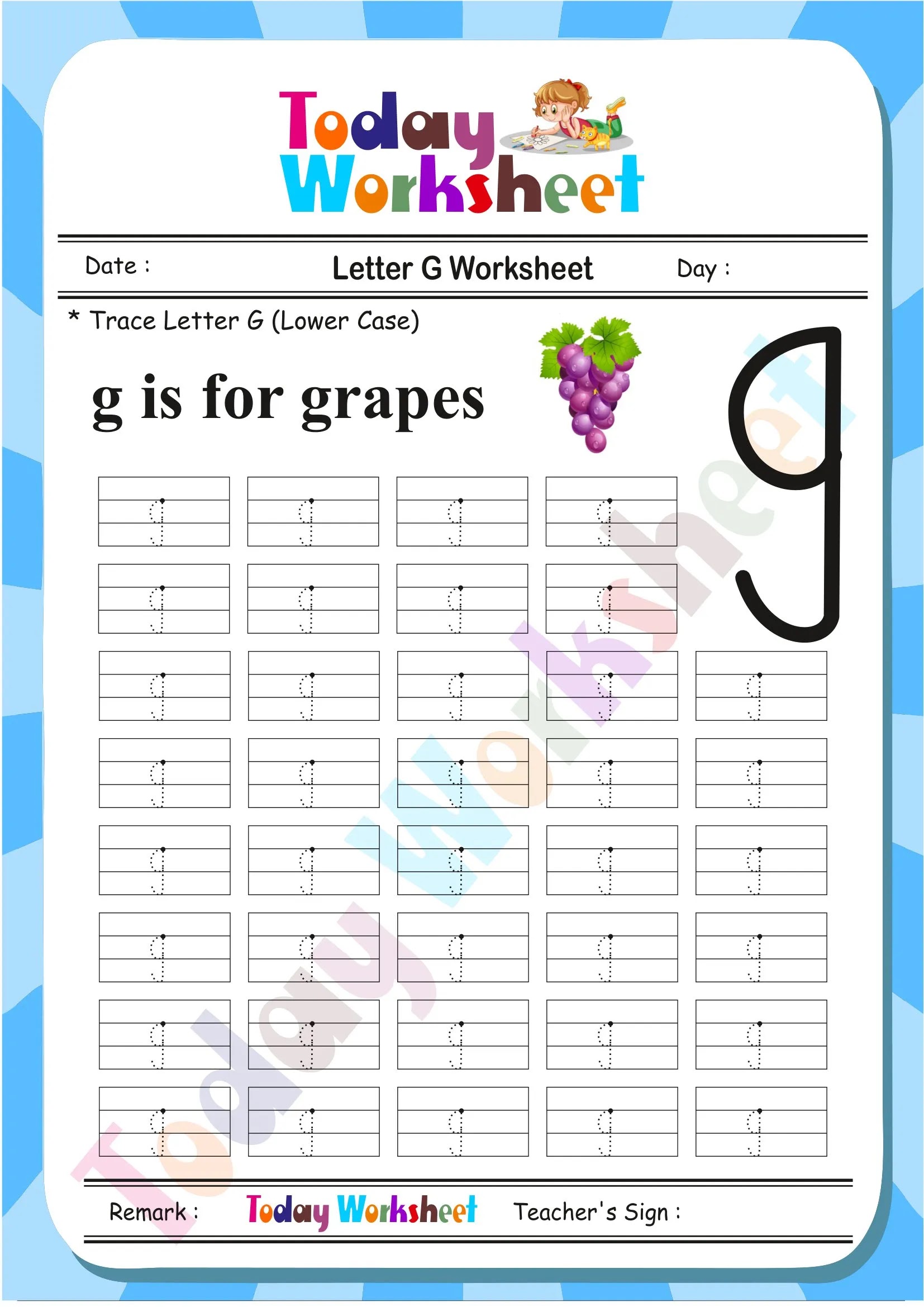
Lowercase g tracing rows build the control needed for the descender loop, one of the more complex strokes in the alphabet.
G for Grapes — Coloring Activity
Grapes were chosen as the coloring anchor for letter G because the hard /g/ sound is heard clearly at the start of the word, and the clustered-circle shape of a grape bunch gives preschoolers an easy, low-pressure area to fill in with color.
Coloring while saying the word out loud — "guh-grapes" — reinforces the connection between the printed letter G and its sound, turning a quiet coloring task into an active phonics exercise.

Coloring the grapes page reinforces the hard /g/ sound while giving little hands a low-pressure shape to fill in.
How to Use This Letter G Worksheet for Preschool and Kindergarten
- Letter-of-the-week unit — pair with a garden or fruit theme built around G words like grapes and goat
- Literacy centre rotation — laminate the tracing pages and let children practice with dry-erase markers so the set can be reused
- Morning work — a quick 5-minute warm-up before circle time
- Homework — send home for extra practice between letter-of-the-week units
- Remedial support — reinforce hard G recognition one-on-one before introducing the soft G sound later on
- Multisensory extension — have your child trace a large G in a tray of sand or shaving cream, or shape one from a rope of playdough, before picking up a pencil
Free Download — Letter G Worksheet PDF
This letter G worksheet PDF includes all three pages — uppercase tracing, lowercase tracing, and the G is for Grapes coloring page — in one printable file.
⬇ Download Free Letter G Worksheet PDF
Free for personal and classroom use | Print on A4 or US Letter paper | No email required
Frequently Asked Questions about Letter G Worksheets
What sound does the letter G make for preschoolers?
How do you write uppercase G?
How do you write lowercase g?
What are G words for preschoolers?
Is this letter G worksheet free?
What's the difference between hard G and soft G?
Why is the letter G important for early literacy?
📚 View all Alphabet Tracing Worksheets A–Z